Paid Search

Influencer Integration Strategies: Whitelisting, Spark Ads, and Creator Partnerships That Scale

A one-off influencer post is not a strategy. It is a media buy with a short shelf life. You brief the creator, they post, and the content disappears into the feed within 24 to 48 hours, along with whatever budget you spent to make it happen.

The brands that are winning with creator marketing right now have figured out a different approach. They are treating creators as a core piece of their paid social infrastructure. They are whitelisting top-performing content, running it as Spark Ads, and building long-term partnerships that compound over time. And critically, they are using paid amplification to turn good creative into a scalable growth channel.

This post breaks down how those programs work, why the performance data supports them, and how to build them without making the mistakes most brands make the first time around.

What These Terms Actually Mean

Influencer Whitelisting 

Whitelisting means the brand runs paid ads through the creator's account handle. Each platform has a variation of Whitelisting, which is further outlined below. 

Partnership Ads on Meta

The creator grants permission through Meta Business Manager, and the brand controls targeting, budget, and optimization in Ads Manager. The ad shows both the creator's handle and the brand's handle, labeled as a paid partnership between the two. The audience sees it coming from a real person they may recognize, with the brand clearly attached. The brand gets the precision of paid media with the credibility of the creator's identity alongside it.

TikTok Spark Ads

Spark Ads are TikTok’s version of the same concept. The creator generates an authorization code from the video's ad settings, the brand inputs that code into TikTok Ads Manager, and the existing organic post gets amplified as a paid ad. All of the existing engagement stays on the post. Every paid impression adds to the like and comment count the creator's audience already sees, which means social proof compounds as the campaign runs.

Content Licensing

Content Licensing is different from whitelisting. With content licensing, the brand owns the rights to use the creator's content on its own channels, running ads from the brand's handle, embedding video on landing pages, or using the content in email. The creative came from a creator, but the distribution and identity are solely the brands.

Dark Posts

Ad-only promotions that never appear on the creator's organic profile. These are useful for testing creative angles without affecting the creator's feed aesthetic or signaling paid activity to their audience.

Why Creator-Led Paid Social Outperforms Brand Creative

The Numbers

Whitelisted ads consistently outperform standard paid social ads by 20% to 50% (Collabstr). On TikTok, Spark Ads deliver 134% higher video completion rates and 37% lower cost per acquisition than standard in-feed brand creative (TikTok for Business). Both numbers come from primary sources and hold up across programs we have seen in the real world.

Why It Works

Users have become extremely good at filtering out brand content. Scroll behavior is fast, and pattern recognition for polished brand creative is even faster. Partnership Ads and Spark Ads disrupt that pattern. The ad shows both the creator's handle and the brand name, clearly labeled as a paid partnership, but it is rooted in the creator's identity and format rather than a brand-produced unit. That difference in how the creative is framed triggers a different response than a standard brand ad.

On top of that, TikTok Spark Ads preserve all existing engagement on the post. Every paid impression adds to the social proof the creator's organic audience has already validated. That flywheel effect is one of the more underappreciated mechanics in paid social right now. You are not starting with a cold ad. You are amplifying something that already showed signs of resonance.

Paid social and creator content are not two separate channels. When you whitelist a creator's post or run it as a Spark Ad, you are closing the distinction between earned and paid media. The creative performs like earned content because it is. The distribution performs like paid media because it is. That combination is the key to paid social success.

Creator Selection: What Actually Predicts Performance

Follower count is a vanity metric. Engagement rate is a better signal, but it does not tell the full story either. What you actually want to know is whether a creator's audience trusts them enough to act on a recommendation. Here is what a rigorous selection process looks at.

Engagement Quality

Look at the comment sections on a creator's posts. Are there genuine responses, questions, and conversations? Or is it mostly emoji reactions and generic replies? The former signals real community. The latter often signals an inflated audience that is not paying close attention.

Sponsored Content Track Record

Look at how a creator handles their brand partnerships. Do the integrations feel native to how they normally post? Or do they feel like a transaction that was awkwardly inserted into their content? Forced endorsements kill performance regardless of how large the following is.

Audience and Brand Alignment

Use tools like Meta Audience Insights or SparkToro to verify that the creator's follower demographics actually match your target customer. A creator with a million followers in the wrong demographic will underperform a micro-creator with 50,000 followers who are exactly your buyer. Misalignment here wastes spend and tends to hurt creator engagement too, because the promoted content does not land with their audience.

Historical Performance Data

If a creator has run brand partnerships before, ask for performance metrics. Click-through rate, conversion rate, audience sentiment after the post. Brands that have worked with the creator before have this data. If you are a new partner, ask for it. If they cannot provide it, that is useful information too.

The Case for Creator Retainers

One of the clearest patterns in influencer marketing data is the performance lift that comes from repeated creator exposure. Audiences do not convert on first contact. They convert when something feels familiar and trusted. A creator who mentions your brand once is a media buy. A creator who mentions your brand monthly for six months is an advocate, and that distinction shows up in the results.

The industry has largely moved in this direction. More brands are choosing retainer and partnership models over one-off posts because the economics improve over time and the trust compounds in a way that a single campaign simply cannot replicate.

The best creator partnerships are structured like long-term media placements, not PR stunts. A three-month pilot with a structured content cadence, clear performance gates, and renewal terms tied to results will outperform twelve separate one-off campaigns with twelve different creators almost every time.

Micro vs. Macro: How to Think About Creator Tiers

Micro-influencers (10K to 100K followers) tend to have higher engagement rates, stronger audience trust, and more defined niche communities. They are often more cost-effective per impression and ideal for testing creative angles and messaging before scaling.

Macro-influencers (500K and above) offer reach and cultural authority, which is useful for awareness objectives, new product launches, or moments where you need volume quickly. Their audiences are broader, which means targeting precision in your whitelisting campaigns matters more.

The most scalable programs use both tiers together. Micro-creators test messaging and creative concepts at lower cost, and the content that proves itself gets scaled through whitelisting spend or replicated with macro-creators who can amplify it further.

What Effective Whitelisting Ads Look Like

On Meta (Partnership Ads)

Meta's Partnership Ads workflow requires influencers’ permission at the account level, not just at the post level. Get permissions set up before a campaign launch. Back-and-forth on access is the most common source of delays, and it is entirely avoidable. A few things that separate programs that scale from ones that plateau:

  1. Test three to five creator angles simultaneously. Treat whitelisted content like any other creative test in Ads Manager. Run parallel campaigns, maintain clear holdouts, and iterate weekly based on results.

  2. Build lookalike audiences from the creator's engaged followers. This is one of the most underused targeting levers in Partnership Ads. You get the credibility of the creator's identity combined with Meta's targeting infrastructure pointing the ad at people who look like the creator's actual audience.

  3. Use Advantage Plus Shopping alongside Partnership Ads for e-commerce clients. The combination of creator identity and Meta's automated placement optimization has shown consistent return on ad spend improvement.

Budget accordingly for a meaningful test window. A 7-day run per creative is a reasonable minimum to generate reliable learnings before making optimization decisions.

On TikTok (Spark Ads)

TikTok's authorization process is simpler than Meta's. The creator generates an 8-digit code from their video's ad settings, you input it into TikTok Ads Manager, and you are running. The ramp time is faster, but the execution details still matter.

  1. Hook first. TikTok's algorithm prioritizes content that holds attention in the first two seconds, and Spark Ads follow the same logic. Brief creators on this explicitly. The hook is the most important creative decision in the entire video.

  2. Lock music rights before authorization. If a creator used a trending sound you do not have commercial rights to, the ad cannot run. Resolve this at the brief stage, not the launch stage.

  3. You cannot edit captions after authorization. The video that gets authorized is the video that runs as a paid ad. Get captions and calls to action right before the code is generated.

  4. TikTok Shop commission mechanics interact meaningfully with Spark Ads. Creators whose content is amplified through Spark Ads can see significant commission increases, which creates a strong incentive for creators to produce better content and invest in the partnership.

Contracts and Rights: What Cannot Be Skipped

Here is what happens when brands skip the contract work: they run a campaign, the creator gets uncomfortable with how much media spend is running through their handle, the relationship sours, and the program shuts down. Or the authorization window expires mid-campaign and the ads go dark. Or a creator issue surfaces and there is no takedown clause in place. A solid whitelisting agreement covers the following:

  1. Permission scope. Account-level versus post-level access, and which placements and formats are included.

  2. Duration and renewal terms. Authorization windows, pre-agreed renewal fees, and timeline expectations on both sides.

  3. Edit rights. Whether the brand can modify copy, calls to action, or captions, and to what extent.

  4. Exclusivity. Whether the creator can work with competing brands during the campaign period.

  5. Takedown provisions. Clear pause rights and rapid-response protocols if a creator situation requires it.

  6. FTC disclosure. Paid partnership language must appear as on-screen text within the first three seconds of video content. The platform-level partnership toggle alone does not satisfy FTC requirements.

What to Track and How

Influencer marketing measurement has historically been messier than most performance channels, but it is becoming more structured as brands move more of their creator activity through paid infrastructure.

For whitelisted and Spark Ad campaigns, measurement lives in your ads manager, not in the creator's organic analytics. Return on ad spend, click-through rate, conversion rate, and cost per acquisition can all be tracked directly against your standard performance benchmarks. Treat these campaigns like any other paid social campaign.

For organic creator content, use UTM parameters on all landing pages and set clear attribution windows. A 7-day click, 1-day view attribution window is a reasonable starting point for most brands. First-touch and last-touch models both miss something in creator campaigns, so consider a multi-touch approach for programs that have been running long enough to generate the data.

For long-term partnership programs, track brand search lift, repeat purchase rate from creator-attributed customers, and engagement quality trends over the life of the relationship. These are the metrics that tell you whether you are building something durable, not just buying short-term impressions.

How Revel Marketing Partners Think About This

The creator marketing programs that perform at scale have one thing in common: they are built around paid social infrastructure, not around posting schedules. Whitelisting and Spark Ads are what make creator content scalable. Long-term partnerships are what make it sustainable.

The brands seeing the best results are not necessarily working with the biggest creators or spending the most money. They are the ones that built systems around their creator relationships. They test, they measure, they amplify what works, and they invest in partnerships that compound over time.

A one-off creator post is a media buy. A whitelisted creative asset running through paid social is a performance channel. The goal of any well-built influencer program should be to make as much of the former into the latter as possible.

Ready to Build a Creator Program That Scales?


At Revel Marketing Partners, we help brands build influencer programs that go beyond one-off posts. From creator vetting and whitelisting strategy to Spark Ads execution and ongoing optimization, we know how to make paid social and creator content work together. Whether you are launching your first creator campaign or looking to scale what is already working, we can help.

SOURCES

The New PMax: Advanced Segmentation Strategies Using Asset Groups and Channel Insights

If you’ve been managing PMax campaigns for any amount of time, you probably have a complicated relationship with them. The performance can be genuinely great. The transparency? Historically terrible. For a long time, “trust the algorithm” was less a strategy and more a coping mechanism. You could see what was converting, but you had almost no idea which asset groups were pulling weight, which channels were eating your budget, or whether Google’s AI was doing something smart or just confidently wrong.

That’s changed pretty meaningfully over the past year. The updates that have rolled out since early 2025 are worth talking through seriously. Not because PMax is suddenly perfect, but because the tools now exist to be actually strategic about it, if you know what to do with them.

Asset Group Segmentation: What It Actually Unlocks

For most of PMax’s existence, performance data was essentially stuck at the campaign level. You could see clicks, conversions, and ROAS, but none of it was broken out by asset group, which made it genuinely hard to make good structural decisions. Our team has been running third-party scripts to get around this, which calculates channel distribution by pulling display, video, and shopping asset data separately and deriving “search” as whatever spend is left over. Useful, but it’s an approximation, not a direct data pull. And even with that workaround, asset group-level breakdowns, conversion windows, and device splits by group still weren’t accessible. Without something like that in place, you were essentially flying blind on which parts of the campaign were actually working.

In early 2025, Google rolled out asset group segmentation across all PMax campaigns. From the asset group table view, you can now segment results by device, time, conversion action, and a “Top vs. Others” ranking that shows relative asset performance. You can also see days to conversion broken out at the asset group level, which is something we hadn’t been able to access before, even with scripts.

That last one is more useful than it sounds, and it’s genuinely become one of our favorite things to show clients. On accounts with longer purchase cycles (luxury goods, high-consideration DTC, anything with a meaningful research phase), days to conversion tells you something real about how an asset group fits into the customer journey. If one group consistently converts at a 10–14 day lag while another converts same-day, those groups need to be evaluated differently. Applying the same efficiency benchmark to both is going to cause you to make bad decisions. We see this constantly on accounts we audit, and it’s usually the thing that explains why a “low-performing” group was actually doing important work.

One other thing worth mentioning: all of this data is now downloadable. Small quality-of-life thing, but if you’re building client reporting outside of the Google Ads UI (which we always are), it matters.

How We’re Thinking About Asset Group Structure Now

The biggest misconception about PMax structure is that it’s mainly an organizational exercise. It’s not. Asset groups are how you communicate business logic to an algorithm that has no idea what your margins look like, which products are strategically important this quarter, or which customers you actually want to acquire vs. retain. If you set it up loosely, it will optimize loosely.

The most common thing we see in audits is asset groups built around product categories without any thought to the underlying business logic. That’s a starting point, not a strategy. The more useful question is: what do you actually need to be true for this campaign to succeed, and does your structure reflect that?

For ecommerce accounts, margin is usually the right first lens. Your high-margin products and your clearance items should not be competing for the same budget against the same ROAS target. The algorithm will happily spend aggressively on low-margin bestsellers because they’re easy to convert, while your high-margin items that need more reach don’t get enough budget to generate data. Separating them with different targets gives Google clearer guidance about what “good” actually means for each group.

Audience intent is the other axis we think about a lot. A group built around Customer Match lists of your existing buyers needs different creative, different messaging, and probably a different conversion goal than a group targeting custom segments based on competitor search behavior. Bundling those signals together limits what the algorithm can learn from each of them. We know there are performance lifts from splitting audience signal types into their own groups and giving each one tailored creative. With the new segmentation data, you can actually validate whether that structure is working, which changes the client conversation significantly.

A few other structural things worth calling out:

  • Search themes are still one of the most underused levers in PMax. Google quietly doubled the limit from 25 to 50 per asset group in August 2025. Think of them less like keywords and more like intent signals you’re feeding Google to help it find the right traffic faster. Check the usefulness indicator regularly and swap out low-scoring themes. You want every slot working for you.

  • Brand exclusions got a meaningful update in 2025: you can now apply them specifically to Search text ads while leaving Shopping ads open to run on branded queries. For retail clients, this matters a lot. You want to protect brand terms in a dedicated Search campaign while still capturing branded Shopping impressions in PMax. Before this change, it was all-or-nothing. Now you can be more surgical about it.

  • Asset group count is not a metric to optimize for. A campaign with 15 asset groups and a $100/day budget is going to have groups that never gather enough data to exit the learning phase. Consolidation with good structural logic beats fragmentation with granular categories. We generally aim for 5–10 when budgets allow, but tighter accounts can perform well with 3–5 well-funded, well-structured groups.

Channel Performance Reporting: The Thing That Actually Changes the Conversation

If there’s one 2025 update that shifted how we talk about PMax with clients, it’s channel performance reporting. It launched in beta at Google Marketing Live in May and has been rolling out broadly since. As of November 2025, it’s available across all PMax campaigns. Genuinely, we were relieved when it started rolling out.

What it gives you is a breakdown of results across Search, Shopping, YouTube, Display, Discovery, Gmail, Maps, and Search Partners. Clicks, impressions, conversions, conversion value, and cost, all broken out by channel, with format-level detail and a downloadable distribution table. This is the data people have been asking Google for since PMax launched.

What it does most immediately is confirm or challenge your assumptions about where your budget is actually going. We’ve pulled channel reports on accounts that looked great at the campaign level and found real imbalances: significant spend going to channels that weren’t contributing meaningfully to conversions, or channels that were punching well above their weight but getting no creative investment. Neither of those shows up in campaign-level reporting alone.

The thing to understand about channel allocation in PMax is that you can’t control it directly. Google decides where to bid based on predicted conversion probability in real time. But you can influence it:

  1. More search themes = more Search exposure

  2. More video assets = more YouTube and Display

  3. Campaign-level negative keywords (now available for all advertisers, up to 10,000 per campaign) reduce wasted spend on Search and Shopping, which effectively shifts budget elsewhere

These aren’t perfect controls, but they’re real levers, and the channel report is what tells you which ones to pull.

The other thing channel data is good for is distinguishing creative problems from channel problems. If Display is generating a lot of impressions but terrible conversion rates, that’s not necessarily a reason to deprioritize Display. It might mean your image assets aren’t strong enough for that format. The channel performance report now includes creative recommendations linked to an AI-powered image editor in Google Ads, which is a genuinely useful workflow for accounts where creative resources are stretched.

PMax and Your Other Campaigns: The Cannibalization Question

This is something we get asked about constantly, and it’s genuinely under addressed in most PMax content, so we want to spend some time on it. How PMax interacts with your existing Search and Shopping campaigns depends a lot on how your account is set up, and getting it wrong is expensive.

Google’s documented priority system is straightforward in theory. If a user’s query is an identical match to an exact match keyword in one of your Search campaigns, that Search campaign takes priority over PMax. But in practice, there’s meaningful overlap that doesn’t get caught by that rule. A large-scale study by Adalysis across more than 3,300 non-retail PMax campaigns found that Search campaigns had higher conversion rates for overlapping search terms 84% of the time. When PMax wins the auction for terms your Search campaign is also targeting, you’re usually getting a worse outcome than if Search had shown instead.

The fix isn’t complicated, but it requires deliberate account structure. Run a dedicated brand Search campaign with well-funded budgets and exact match coverage for your brand terms, and apply brand exclusions to PMax to keep it from stepping in on those queries. If your brand Search campaign is budget-capped or has gaps in match type coverage, PMax will fill that vacuum. Not because it’s greedy, but because the system is designed to find conversion opportunities wherever it can. We monitor brand Search impression share closely after any PMax launch or restructure, and watch for volume drops that might signal PMax is absorbing traffic it shouldn’t be.

One structural thing we’ve started building into accounts more explicitly: aligning bid strategies between PMax and Search so they’re not inadvertently outbidding each other for the same queries. When PMax is set to a higher effective CPA target than your Search campaign for overlapping terms, PMax will win the auction more often, even when Search would have performed better. That’s a self-inflicted problem worth auditing in any account where PMax and Search are running simultaneously.

What the New Reporting Doesn’t Tell You

We want to be upfront about the limits here, because there’s a real risk of over-reading the new data.

Channel reporting shows you where budget went. It doesn’t explain why performance differed across channels. That interpretation is still on you. Asset group performance metrics can also be tricky because groups within the same campaign share traffic and audiences. A group that looks weak may be benefiting from or contributing to other groups in ways that aren’t visible in the data. Attribution within PMax is still messy, and the new reporting doesn’t fix that.

The “low performance” labels Google applies to assets are relative. They’re comparing your creative against other creative in the account, not against any external benchmark. Don’t pull an asset just because Google flags it. Ask whether it’s serving a purpose (awareness, a longer consideration cycle, a specific audience) before making that call.

And the learning phase is still real. If you restructure your asset groups or make significant budget changes, give the campaign at least two weeks before drawing conclusions. The data you’re looking at during that window isn’t stable.

Where to Start if You Haven’t Revisited Your Pmax Setup Lately

Pull your channel performance report first. Even just knowing where your budget is actually going changes the conversation, both internally and with clients. From there, work through this list:

  • Check your asset group structure against your actual business goals. Are the groups organized around what matters, or around what was convenient to set up?

  • Separate your audience signal types if you haven’t already. Loyalty lists, prospecting segments, and competitor-based signals should each have their own group.

  • Max out your search themes (you now have 50 per group) and review usefulness scores regularly.

  • Add campaign-level negative keywords if you haven’t yet. Start with your search terms report. There’s almost always quick waste to cut.

  • Audit brand Search impression share to make sure PMax isn’t absorbing traffic your dedicated brand campaign should be capturing.

  • Check bid strategy alignment between PMax and Search campaigns to avoid inadvertent self-competition.


None of this is complicated in isolation. The hard part is doing it with enough consistency and patience to let the algorithm actually learn from the structure you’ve built. That’s always been true of PMax. What’s different now is that you can actually see whether it’s working.

Every account teaches us something new about how PMax actually behaves in the wild, and we’d genuinely love to hear how other teams are handling it. Are you segmenting by margin, audience intent, both? Have you pulled your channel report yet and found something surprising? Drop a comment or reach out to the RMP team. We’d love to compare notes.

SOURCES

Google Ads 2026 Interface Updated: What Changed, Where Everything Shifted, and the Features that Actually Matter

If you're running Google Ads in 2026, you've probably logged in and thought: "Wait, something's different here.”

You're not wrong. Google didn't announce a big redesign, but they quietly reorganized the entire interface around AI tools, creative management, and full-funnel measurement. Some features moved. New hubs appeared. And if you're not paying attention, you're missing tools that could actually move the needle.

The changes reflect a bigger shift: search behavior is evolving, AI is disrupting how people research, and the old playbook isn't enough anymore. Let's break down what actually changed in the interface, where Google shifted things, and which new features matter in 2026.


Why 2026 Feels Different

Search behavior is changing fast.

People are increasingly leaning on AI tools like ChatGPT, Google’s AI experiences, and ad advisors to do their research. That means fewer traditional searches, fewer clicks, and more competition for the searches that still show strong buying intent.

If you think you're imagining the drop in clicks, you're not. Search Engine Land tracked CTR falling 61% for organic and 68% for paid since AI Overviews launched. Informational searches dominate, while high-intent clicks, the ones worth paying for, are getting scarcer and more expensive.

If your business is just chasing clicks, you’re going to struggle. But the foundation hasn’t changed: relevance still wins. Ads that clearly match user intent and promote a proven offer continue to perform, even in a more competitive environment. Think of it like this: AI is doing a lot of the research for your potential customers. If your campaign isn’t optimized for that, you’re invisible.


What’s New in the Google Ads Interface

Performance Insights Are Deeper and More Actionable

Performance reporting now breaks down across eight channels: Shopping, Search, Display, YouTube, Gmail, Discover, Maps, and Partners. Translation? You can finally see where your conversions are actually coming from, especially for video campaigns where YouTube and Display Network performance were always a black box.

The upgrade isn't just more numbers. You get:

  • Expanded performance metrics

  • Asset level and channel level visibility

  • AI-driven recommendations surfaced closer to key decision points

This is especially noticeable in Performance Max, where reporting helps explain why performance is changing, not just what happened.

YouTube & Demand Gen: Measuring Brand Impact

Google is rolling out Attributed Brand Searches, which will show whether users search for your brand after viewing video ads.

Even if video doesn’t drive immediate conversions, you’ll be able to see its downstream impact on branded search behavior.

AI Chatbots Are Everywhere Now

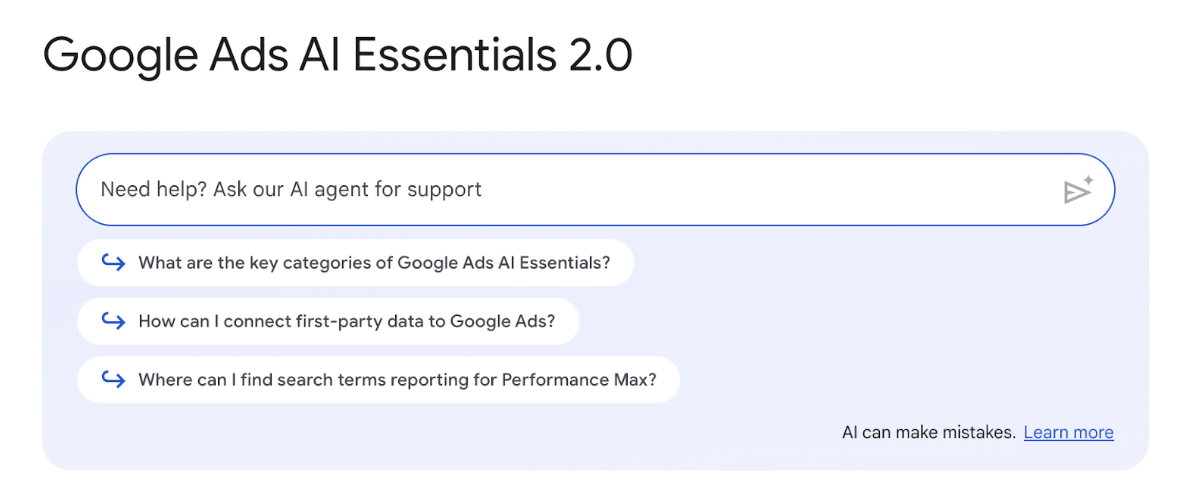
Google went all-in on AI chatbots. Both Google Ads and Analytics now have chat assistants that surface insights and recommendations. They're helpful, but they don't take action, you still have to do the work.

The bigger shift? Support. The direct support form is gone, replaced with an AI chatbot that fields all inquiries first. Human reps still exist, but good luck getting past the bot without going through its troubleshooting routine first.

Creator and Video Tools Have Their Own Space

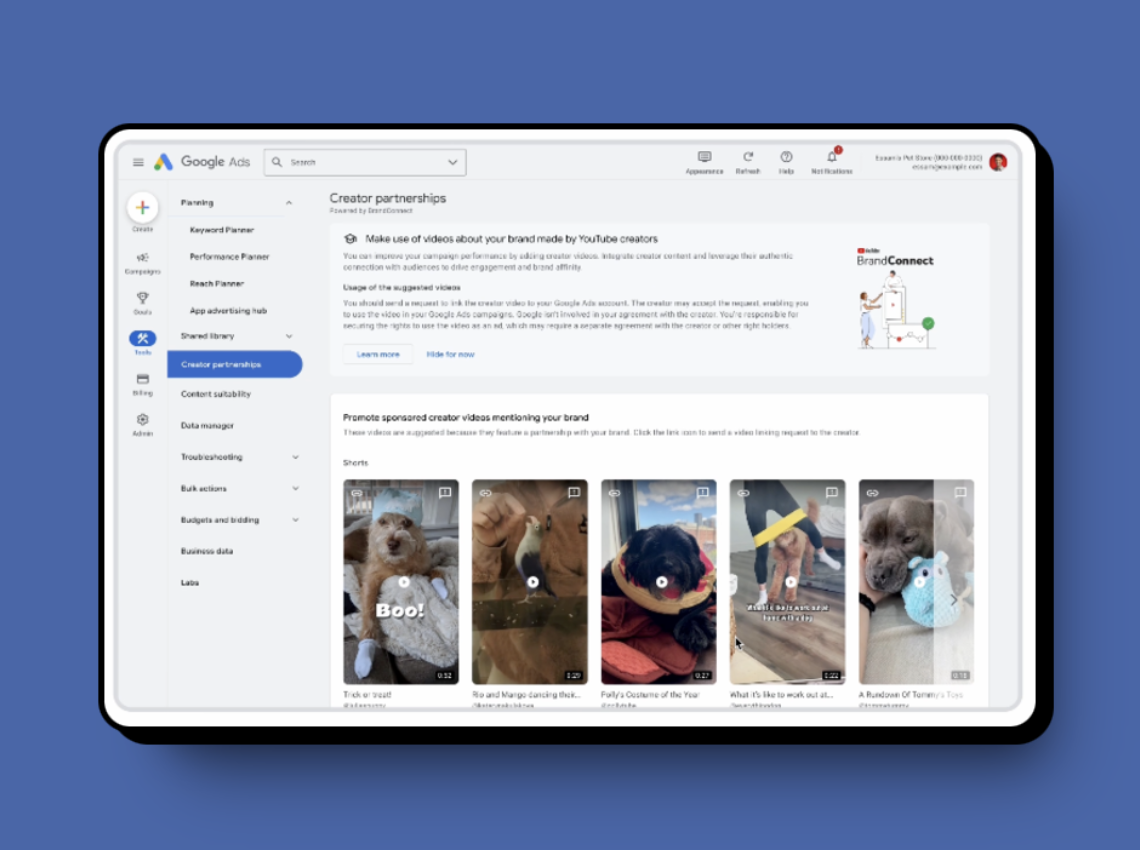
Video just got its own hub. The Creator Partnership Hub gives advertisers a dedicated place to:

  • Discover YouTube creators

  • Explore creator led video content

  • Align video strategy with Demand Gen and YouTube campaigns

This isn't subtle: video and creative aren't optional anymore. They're core to performance.

What This Means for Your 2026 Strategy

The interface updates point to where Google thinks the game is headed. Here's what to prioritize:

  • Use channel-level reporting: Performance Max finally shows you which channels drive results. Stop guessing, start optimizing based on actual data.

  • Set up brand search tracking: If you're running video, use Attributed Brand Searches to prove video's impact beyond direct conversions.

  • Get serious about video creative: Google built a whole Creator Partnership Hub. That's not a hint, it's a directive. Video isn't supplemental anymore.

  • Adapt to AI search behavior: Fewer clicks, higher CPCs, more AI-driven research. Your campaigns need to show up in AI results, not just traditional search.

  • Track the full funnel: With longer conversion paths and AI doing the research, you can't just measure last click anymore.

Revel Marketing Partner’s Bottom Line

2026 isn't about learning a new interface. It's about adapting to how people actually search now, with AI doing the heavy lifting and fewer clicks to go around.

The advertisers who invest in video, use the new reporting tools, and optimize for AI-driven search will win. Everyone else will wonder why their CPCs keep climbing while results stagnate.

SOURCES

2026 Digital Marketing Trends: Expert Predictions for Paid Media & Ecommerce

2026 Digital Marketing Trends: Expert Predictions for Paid Media & Ecommerce

Every January, the digital marketing world floods with predictions: some insightful, many recycled, and a few wildly off base. But 2026 feels different. We're not just watching incremental platform updates or minor algorithm tweaks anymore. We're witnessing fundamental shifts in 2026 marketing trends: how consumers discover products, how platforms deliver ads, and how marketers prove their work actually matters. The gap between brands that adapt and those that cling to old playbooks is about to become a chasm.

So we asked our team at Revel Marketing Partners where they think the industry is headed this year. What follows isn't speculation from the sidelines. These are predictions from the directors and leaders who are already navigating these changes with our clients, and who have strong opinions about what's coming next.

Revel Marketing Partners’ 2026 Digital Marketing Predictions

AI and Headless Commerce Are Reshaping the Shopping Experience

Kayla Faires, Founder & CEO:

"The future of digital marketing is about rebuilding infrastructure so you can move as fast as the platforms change. Two shifts are converging: headless ecommerce architectures, and agentic search systems where AI answers questions and makes recommendations before consumers reach your brand. Creative velocity and experimentation speed now determine ROAS, and legacy platforms are making it harder and harder to deliver. At the same time, discovery is shifting from queries to AI-mediated recommendations. Brands will compete less on keyword ownership and more on structured, machine-readable truth: clean product data, pricing logic, availability, and positioning that agents can interpret and recommend. As automation increases, judgment becomes the differentiator. The winners will pair flexible infrastructure with authentic brand building. Brands that actually stand for something and show their authenticity, while also leaning into new tech will compound advantages while others optimize yesterday's funnel."

Michele Keating, Account Director:

"Short-form video, AR try-ons, and creator demos won't just support ecommerce—they'll replace traditional PDPs. Live shopping will become the default, and UGC becomes the most trusted conversion asset."

AI-Powered Search and the End of Traditional Search Behavior

Abby Peterson, Director of SEM:

"2026 will mark the inflection point for paid search as AI advertising platforms fundamentally compress the user research journey. What once took 10+ searches now happens in a single ChatGPT conversation. Google Paid Search will remain a revenue powerhouse, but declining traffic volumes and intensifying CPCs will force a strategic reckoning: we can no longer afford to bid broadly. Success in this new landscape belongs to marketers who get ruthlessly selective with keyword targeting, double down on high-intent bottom-funnel terms, and maximize every click with precision audience strategies. The brands that will win aren't fighting this shift, they're adapting their strategies across both ecosystems while search is still profitable."

Brandon Elston, Paid Media Specialist:

"Brands that invest in GEO to appear in LLMs like ChatGPT & Gemini, will finally see a noticeable impact on purchases, especially from new customers. With the introduction of Universal Commerce Protocol (UCP) and direct integration of ChatGPT to Shopify, it is becoming increasingly more beneficial for consumers to shop on LLMs compared to search engines. This is because users can shop products across brands and make a purchase all in one ecosystem without browsing dozens of sites for inventory, products, or to find the best deals. A survey from Centerfield last year showed that the top 3 reasons users shop with AI are getting answers to product questions, comparing products or brands, & getting product recommendations, all top of funnel discovery type searches that could lead to discovering new brands and products."

Raw Creativity and Authenticity Will Beat AI Perfection in 2026

Paige Baugnet, VP of Client Services:

"I predict that we'll continue to see authentically raw and unpolished creative perform exceptionally well in 2026 as a direct counter to AI-generated perfection, particularly as consumers become increasingly skeptical about distinguishing real from fake content. In a digital landscape saturated with polished, algorithm-optimized visuals that all start to look eerily similar, people will actively crave authenticity and realness—the imperfect lighting, the shaky camera work, the unfiltered moments that signal genuine human creation. Brands that lean into this 'intentionally unpolished' aesthetic beyond the existing creator playbook will likely see stronger engagement and trust metrics, as audiences reward the vulnerability and transparency that comes with content that feels unmistakably human."

Jessica Shepherd, Chief Operating Officer:

"In 2026, the digital marketing industry will feel the real disruption not through job loss, but through the loss of excuses for mediocre thinking. As AI makes execution cheap, taste becomes a true competitive advantage—especially for beauty, fashion, and lifestyle brands where differentiation lives in nuance, not volume. The biggest brand risk won't be getting AI wrong; it will be sounding like everyone else who got it 'right.' That's why human review will increasingly serve as the new quality assurance layer—not to slow creativity down, but to protect brand distinctiveness in an automated world."

Marketing Mix Modeling, Diversification and the Shift to Incrementality

Amanda Moorhead, Account Director:

"2026 is going to be all about incrementality and accurate measurement for marketing. Last-click attribution isn't telling enough of the story, privacy changes are throwing a wrench into reporting, and relying on the same old methods is going to bring lackluster results. The brands that will unlock growth are those who can answer one critical question: 'What actually moved the needle?' That's why I'm excited to work with my clients on implementing MMM tools and diversifying their media mix. The future isn't about which touchpoint gets credit—it's about proving which dollars are truly incremental."

Gretta Schultz, Director of Paid Social:

"2026 is the year digital marketing finally gets its "infrastructure" right - better measurement, smarter and more consistent/reliable automation, and creative journeys that prioritize sustainable growth over quick wins."

RMP Affiliate Marketing Team:

"We predict affiliate programs will prioritize channel diversification and robust partner vetting following high-profile removals like PayPal Honey, while navigating increased FTC enforcement under the Consumer Review Rule that rewards proactive compliance. We expect the industry to accelerate its shift from last-click attribution toward outcome-based models that credit partnership contributions, as both affiliate and creator marketing mature with greater emphasis on measurable ROI over vanity metrics. Affiliate publishers will continue expanding beyond Google Search dependence through multi-channel strategies spanning social platforms, direct traffic, and emerging opportunities like OpenAI's ChatGPT ads. Meanwhile, long-term creator partnerships will become the standard as brands recognize the value of sustained relationships, with emerging content formats and technologies requiring affiliate programs to evolve their partnership structures and compensation models accordingly."

What This Means for Your 2026 Strategy

The through-line in all of these predictions? 2026 rewards the strategic over the reactive. Whether it's demanding proof of incrementality, embracing rough authenticity over AI polish, adapting to compressed search journeys, optimizing for AI-powered discovery, or protecting brand voice in an automated world, the brands that will thrive are those willing to challenge their assumptions and evolve their approach. The tools are getting smarter, the platforms are getting more automated, and the consumer is getting more discerning. Your strategy needs to keep pace. At Revel Marketing Partners, we're not just watching these shifts happen. We're actively helping our clients navigate them. If any of these predictions hit home and you're wondering how to adapt your own marketing strategy, let's talk. Because the future isn't something that happens to you. It's something you build toward, one smart decision at a time.

Paid Search in 2025: Less Control, More AI, and the Lessons That Matter for 2026

If 2024 was the year Google introduced AI-powered campaigns, 2025 was the year they became the preferred path.

Google did not just roll out new features. It changed how paid search works. Automation moved from helpful to expected. Manual controls shrank. AI stopped assisting and started choosing. Google's message was consistent: Smart Bidding and AI-driven campaigns deliver better results. The problem? Automation didn't guarantee success. Advertisers with strong fundamentals saw impressive gains. Those without them lost ground quickly. The difference came down to understanding what Google's automation actually required, and what it couldn't fix.

2025 Was the Year AI Took the Wheel

Google’s direction was clear throughout the year: manual options are becoming increasingly limited, while AI-powered campaigns are taking center stage.

Enhanced CPC disappeared. Call-only ads got a sunset date. Campaign creation flows nudged advertisers toward automated formats. The message was consistent. This is where paid search is going.

At the center of it all was Google’s Power Pack approach: Performance Max, Demand Gen, and AI Max for Search.

Performance Max continued expanding as the all-in-one campaign type. Demand Gen evolved as a discovery-focused channel. AI Max entered as a Search feature suite promising broader reach through keywordless matching, automated copy, and dynamic landing pages.

For accounts with clean conversion tracking and strong first-party data, results improved. For accounts without that foundation, performance became harder to control.

AI did not fix broken setups. It amplified them.

The Cost of Automation

Google framed 2025 as a year of efficiency. Advertisers felt the cost side more clearly.

Average cost per lead increased year over year, with some verticals, such as retail, seeing 40–50% increases in CPCs over the past five years. While reporting improved, automated campaigns still required a level of trust many advertisers weren’t prepared to give.

Performance Max remained the clearest example. Even with improved reporting, the system required trusting algorithmic decisions over manual intervention. When results dipped, the solution was often to wait for the system to learn rather than make strategic adjustments.

Automation delivered scale, but it demanded surrendering control. In 2025, advertisers had to decide whether that tradeoff made sense.

Brands with authentic, involved, and vocal communities saw significant performance improvement. Brand communities also benefit the brand by providing endless UGC, instant feedback, and primed audiences to assist paid social efforts. 

What Actually Worked in 2025

AI Overviews Opened New Visibility, With Limits

Ads expanded into AI Overviews across more devices and regions. When they appeared, they mattered. These placements show up before users scroll and influence decisions early.

The challenge was consistency. Advertisers could not control when AI Overviews appeared or measure performance in a meaningful way. There was no way to optimize directly for them.

We treated these placements as incremental upside, not a strategy to chase. Strong fundamentals helped. Weak ones did not.

Performance Max Became More Practical

2025 was the first year Performance Max felt usable at scale.

Search term visibility improved. Channel-level reporting became clearer. Asset-level insights actually helped guide optimization. The controls that had always existed, negatives, demographics, search themes, finally had the transparency needed to use them effectively.

When paired with strong feeds, varied creative, and active management, Performance Max delivered. When treated as a set-it-and-forget-it solution, it consistently underperformed.

Creative Became a Performance Requirement

Google’s creative tools removed friction. Asset Studio and in-platform generation made it easier to produce volume quickly.

That mattered because automated campaigns need creative variety to work. Headlines, images, and video now directly influence performance.

The catch was quality. Some AI-generated creative worked well. Some felt generic or off-brand. In testing, assets generated without brand guidance often drove lower engagement and shorter performance windows. When creative inputs were structured and reviewed, we saw stronger CTRs and more stable conversion rates. AI helped scale output, but human direction made the difference.

The brands that performed best used AI for speed, not strategy. Human direction still matters.

Clean Data Became Non-Negotiable

AI-powered campaigns exposed data weaknesses.

Accounts with accurate conversion tracking and proper value assignment outperformed those without by margins exceeding 2x in many cases. Duplicate conversions, missing values, and weak signals led to inefficient bidding and unstable performance.

First-party data like Customer Match helped strong accounts get stronger. It couldn't fix broken fundamentals.

What Didn’t Work and Why It Matters

Blind Adoption of AI Max for Search

AI Max for Search launched in beta with significant buzz, but our early testing revealed clear limitations.

We saw irrelevant keyword matching, exclusions that were not always respected, and clunky setup flows. Automated copy sometimes missed brand intent entirely.

AI Max for Search showed promise as an expansion tool, not a replacement. Used carefully, it uncovered incremental volume. Used blindly, it created noise.

We will continue testing AI Max for Search in 2026, but with guardrails firmly in place.

Treating Performance Max as a Cure-All

Some advertisers tried to consolidate everything into Performance Max. Results usually suffered.

Performance Max excels at scale. It struggles with nuance. Brands with complex catalogs, promotions, or seasonal priorities still needed structured Search and Shopping campaigns.

The strongest accounts used Performance Max alongside other campaign types, not instead of them.

The Control Paradigm

The control paradox isn't going away. Google will continue removing manual options while adding "controls" that operate within automated guardrails.

The creative tension will intensify. As AI generates more assets, brand consistency becomes harder to maintain at scale.

AI optimizes for metrics. Brands care about positioning and voice. Those priorities do not always align.

Revel Interactive’s Bottom Line

2025 made one thing clear: automation is not the problem. Blind automation is.

The advertisers who succeeded weren't the ones who followed every Google recommendation. They were the ones who understood the systems, tested them critically, and intervened when automation couldn't account for business nuance.

2026 will reward that same approach. Clean data, varied creative, and strategic oversight will separate strong performance from mediocre results.

AI is powerful, but it still needs direction. The future of paid search isn't choosing between humans and machines, it's knowing how to use both well.

Sources

Highlights from the Paid Search Association Conference 2025

The Paid Search Association recently held their 2025 digital conference featuring a full day of sessions from the industry’s top speakers from around the world.  The event covered a wide range of topics ranging from display, video, search, artificial intelligence, & more.  We wanted to share our top takeaways from the conference and how advertisers can make the most of the insights shared.


A big theme of the day was without a doubt AI.  Multiple sessions including those from Fred Vallaeys & Mike Rhodes covered ways to integrate AI into paid marketing. For example, Mike discussed how to use AI to help create intricate scripts to help gain valuable insights into paid ad accounts. Fred shared a number of advanced ways to utilize AI like using search terms to then suggest blog ideas and creating different personas to provide feedback from various points of view.  However, the session that stayed with me was the one that kicked the event off by Ameet Khabra.  Her topic surrounded AI in PPC and where AI shined vs where humans shined.  The cases Ameet shared included one where they put AI up against a copywriter to see who could produce the top performing ad copy, spoiler the human won.  She also shared how AI is able to help scale the ad creation process for businesses.  Ultimately Ameet’s presentation wasn’t about one being better than the other, but that together marketers can play off AI’s strengths while injecting our own knowledge of our client’s businesses and best practices to drive the best results.  


If you’d like to dive deeper into AI and how to rank in AI results be sure to read this article on Generative Engine Optimization.


Another topic I found interesting is Navah Hopkins’s presentation on challenging PPC biases with data.  A key value we share at Revel is strategic impact, which means we are constantly looking at the data to identify actionable insights we can use to achieve our goals, which aligns perfectly with Navah’s topic.  She started the discussion defining biases and why people might have them when it comes to their PPC advertising, examples such as, information delivered from a supposed “expert” or a norm in the industry that people are comfortable without questioning.  Navah then went on to dispel multiple common beliefs in the PPC industry, backed by data from Optmyzr.  


One example of a bias in PPC is search ad capitalization.  In every agency I have worked at, the best practice has always been to write all search ads in title case, capitalizing the first letter in every word of an ad.  With Navah’s data she shared, it showed that sentence casing, capitalizing the first letter of every sentence in an ad, overall performed better than title casing!  This and the other data she shared has been a great conversation starter for our teams internally identifying other biases we would like to test against the data we have for our clients.


The day closed out with a presentation from Ginny Marvin, Google’s Ad Liaison, on Google Ads in 2025.  In PPC everything is constantly evolving and Ginny was able to share a recap of some of the recent changes to Performance Max & Demand Gen campaign types.  While she wasn’t able to share any brand new updates with us, she did say that with AI overviews playing a more critical role in the SERP, Google is testing new ways to deliver the best value for users and advertisers. Also, to keep an eye out for new ways to reach users in the near future.


With that, the PSA Conference 2025 came to a close.  We greatly appreciated hearing from such a fantastic group of speakers and look forward to next year’s event!  To watch the full 2025 conference be sure to visit the Paid Search Association’s YouTube channel and for other digital marketing news stay tuned to the Revel Interactive blog.


Photo: © ChristianChan from Getty Images

Optimizing A Google Merchant Feed: A Strategic Roadmap for Success

Optimizing A Google Merchant Feed: A Strategic Roadmap for Success

In the ever-evolving landscape of paid media, change and the constant shift toward automation can be daunting. We at Revel like to reframe this from a “loss of control” to the campaign potential that opens up when we master what we can control. Enter: inputs. Acknowledging the pivotal role of inputs, especially a high-quality data feed, is the first step to optimizing your PPC campaigns, be it on Standard Shopping or Performance Max.

The Best Google Ads Extensions for Ecommerce Businesses

The Best Google Ads Extensions for Ecommerce Businesses

Revel Interactive has worked with dozens of ecommerce businesses over our 11+ years of service. More often than not, Google Ads is an essential part of any paid media mix, especially when it comes to ecommerce businesses. Google Ads has the ability to reach users that are actively shopping for products like yours, and has advanced bidding strategies to help your ads show to users likely to purchase. While anyone can set up a Google Ads campaign, it takes years of experience to know which settings will make or break your business.