Revel Marketing Partners

Creative Testing in 2026: Adapting to Meta’s AI-Driven Advertising Platform

Meta Is AI-First Now. Creative Testing Has to Be Too.

Meta advertising in 2026 looks fundamentally different. The platform isn’t just adding automation — it’s rebuilding ad delivery around AI.

At Meta’s 2026 Outlook, AI was declared the company’s “North Star.” That shift is visible everywhere: how ads are retrieved, ranked, tested, and optimized across Facebook and Instagram.

For advertisers, that creates both opportunity and confusion.

Creative testing is happening at higher volume than ever — but often with less clarity around what’s actually driving performance.

At Revel, our POV is simple: Creative testing isn’t dead. But the old way of testing is.
In an AI-driven advertising environment powered by Meta Andromeda and Advantage+, the brands that win aren’t chasing perfect A/B tests. They’re building smarter creative systems, feeding the algorithm differentiated inputs, and iterating based on real performance signals.

The Revel 2026 Creative Testing Playbook: How to Win on Meta in an AI-Driven Ecosystem

Meta’s automation rewards advertisers who work with the system, not against it.

In 2026, strong creative testing strategy comes down to five principles:

  1. Prioritize differentiated creative angles

  2. Consolidate campaign structure

  3. Monitor asset-level signals

  4. Design for AI remixing

  5. Iterate before performance declines

Here’s how that applies across Meta’s newest updates.

Automated Creative Testing Tool

What It Is: Meta’s Automated Creative Testing tool allows advertisers to test creative at the ad level within an existing ad set. Instead of running manual A/B campaigns, the system splits delivery fairly across variations while still optimizing performance.

This reflects a broader shift in Facebook ad optimization: testing and scaling now happen inside the same ecosystem.

Revel POV: Testing should fuel scaling — not slow it down. Isolated A/B campaigns often fragment budgets and distort learning. Meta’s built-in testing tools are designed to generate insights within real delivery conditions.

What We Recommend:

  • Test 3–6 meaningfully different variations at once.

  • Change the hook, angle, or offer, not just surface elements.

  • Focus on creative variety over creative volume.

Forty minor edits won’t outperform five strategically different angles. AI-driven advertising systems learn from contrast, not repetition.

Creative Breakdown Reporting

What It Is: Creative Breakdown reporting provides asset-level performance insights within Flexible formats. You can see how individual images and videos perform, which now includes AI-generated assets, rather than relying on blended campaign averages.

In addition, there is a new key metric joining the list when we talk about creative analysis. CPMr (cost per 1,000 reached) is emerging as a critical metric for evaluating creative testing results, especially as an early indicator of fatigue. When CPMr climbs, you’re not buying more opportunity—you’re paying more to reach the same people. If CPMr spikes, the answer usually isn’t adjusting bids—it’s refreshing your creative.

Revel POV: Campaign averages are outdated. Asset-level data is the new baseline. Meta’s system constantly remixes placements and formats. If you’re judging performance at the campaign or ad set level alone, you’re missing what the AI is actually rewarding.

What We Recommend:

  • Review creative breakdown weekly during active scaling.

  • Identify top-performing assets and build iteration cycles around them.

  • Compare AI-generated creative to original creative intentionally:

    • Does it lower CTR?

    • Does it extend creative lifespan?

    • Does it reach new segments?-

Creative performance analysis is no longer optional — it’s foundational to modern performance marketing strategy.

Advantage+ and Flexible Formats

What It Is: Advantage+ campaigns and Flexible formats allow Meta’s AI to dynamically assemble and deliver creative combinations across placements.

Your ad is no longer static. The system tests variations across Reels, Stories, Feed, and more — then serves the highest-performing combination per user.

Revel POV: If you’re not designing for AI remixing, you’re limiting performance. Meta’s automation is powerful — but only if your creative assets are built to flex. Weak cropping, unclear hooks, and placement-specific formatting issues can undercut performance before optimization even begins.

What We Recommend:

  • Build creative modularly:

    • Hooks that land in the first 1–2 seconds

    • Messaging that survives cropping

    • Clear product benefits without relying on tiny text

  • Think in creative systems, not individual ads.

  • Consolidate campaigns to strengthen learning signals.

Advantage+ rewards advertisers who simplify structure and strengthen creative inputs.

Meta Andromeda: The AI Engine Behind Ad Delivery

What It Is: Meta Andromeda is a next-generation AI ad retrieval engine that determines which ads are eligible to be shown to which users, before ranking even occurs.

It processes massive pools of ad candidates in real time, using behavioral signals to retrieve the most relevant ads at scale. This shift underpins how Meta advertising works in 2026.

Revel POV: Creative is now your targeting strategy. In the past, advertisers relied heavily on interest targeting and manual segmentation. In the Andromeda era, Meta depends more on behavioral signals and creative relevance to match ads to users.

Your creative isn’t just messaging; it’s a machine-readable signal for audience matching.

What We Recommend:

  • Align creative volume with budget and data.
    Too much creative without enough spend slows learning.

    • Smaller budgets → tighter, intentional sets

    • Scaling budgets → expand strategically

  • Build differentiated angles.
    Creative diversification should include:

    • Distinct pain points

    • Unique emotional triggers

    • Different product benefits

    • Varied messaging frameworks

  • Simplify structure.
    Over-segmentation weakens signal strength in AI-driven advertising systems.

  • Invest in clean data.
    Pixel and Conversions API setup directly impact Meta Andromeda’s optimization capabilities. Strong data improves AI matching.

Advantage+ rewards advertisers who simplify structure and strengthen creative inputs.

Final Takeaway: Winning Creative Testing in 2026

Meta’s AI-first infrastructure isn’t reducing the importance of creative. It’s amplifying it.

The brands that win in AI-driven advertising environments:

  • Systemize creative production

  • Consolidate campaigns

  • Invest in clean tracking

  • Monitor asset-level signals

  • Iterate before performance declines

Meta is building AI-first delivery. We build AI-ready performance marketing programs that work inside it.

SOURCES

Google Ads 2026 Interface Updated: What Changed, Where Everything Shifted, and the Features that Actually Matter

If you're running Google Ads in 2026, you've probably logged in and thought: "Wait, something's different here.”

You're not wrong. Google didn't announce a big redesign, but they quietly reorganized the entire interface around AI tools, creative management, and full-funnel measurement. Some features moved. New hubs appeared. And if you're not paying attention, you're missing tools that could actually move the needle.

The changes reflect a bigger shift: search behavior is evolving, AI is disrupting how people research, and the old playbook isn't enough anymore. Let's break down what actually changed in the interface, where Google shifted things, and which new features matter in 2026.


Why 2026 Feels Different

Search behavior is changing fast.

People are increasingly leaning on AI tools like ChatGPT, Google’s AI experiences, and ad advisors to do their research. That means fewer traditional searches, fewer clicks, and more competition for the searches that still show strong buying intent.

If you think you're imagining the drop in clicks, you're not. Search Engine Land tracked CTR falling 61% for organic and 68% for paid since AI Overviews launched. Informational searches dominate, while high-intent clicks, the ones worth paying for, are getting scarcer and more expensive.

If your business is just chasing clicks, you’re going to struggle. But the foundation hasn’t changed: relevance still wins. Ads that clearly match user intent and promote a proven offer continue to perform, even in a more competitive environment. Think of it like this: AI is doing a lot of the research for your potential customers. If your campaign isn’t optimized for that, you’re invisible.


What’s New in the Google Ads Interface

Performance Insights Are Deeper and More Actionable

Performance reporting now breaks down across eight channels: Shopping, Search, Display, YouTube, Gmail, Discover, Maps, and Partners. Translation? You can finally see where your conversions are actually coming from, especially for video campaigns where YouTube and Display Network performance were always a black box.

The upgrade isn't just more numbers. You get:

  • Expanded performance metrics

  • Asset level and channel level visibility

  • AI-driven recommendations surfaced closer to key decision points

This is especially noticeable in Performance Max, where reporting helps explain why performance is changing, not just what happened.

YouTube & Demand Gen: Measuring Brand Impact

Google is rolling out Attributed Brand Searches, which will show whether users search for your brand after viewing video ads.

Even if video doesn’t drive immediate conversions, you’ll be able to see its downstream impact on branded search behavior.

AI Chatbots Are Everywhere Now

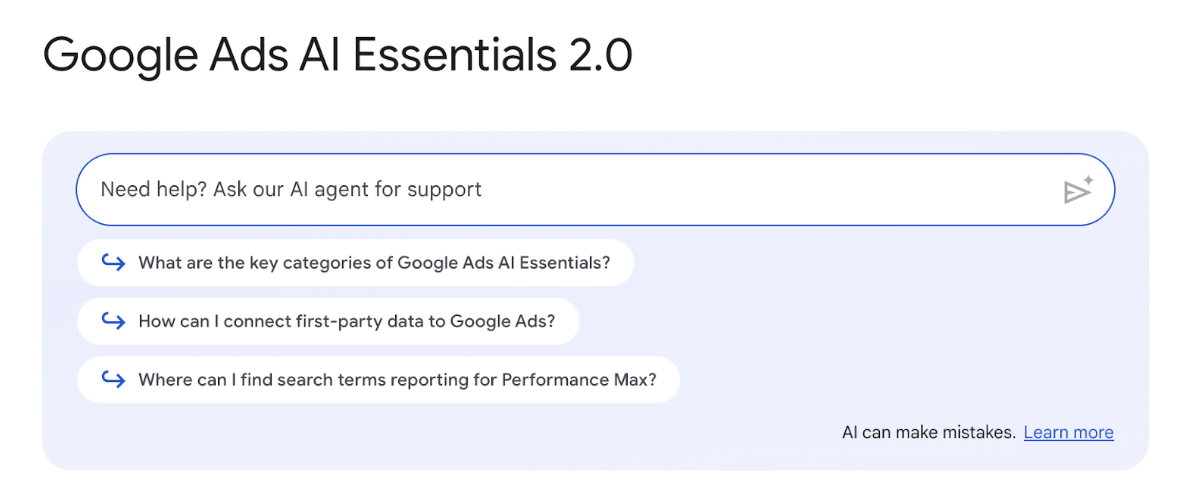
Google went all-in on AI chatbots. Both Google Ads and Analytics now have chat assistants that surface insights and recommendations. They're helpful, but they don't take action, you still have to do the work.

The bigger shift? Support. The direct support form is gone, replaced with an AI chatbot that fields all inquiries first. Human reps still exist, but good luck getting past the bot without going through its troubleshooting routine first.

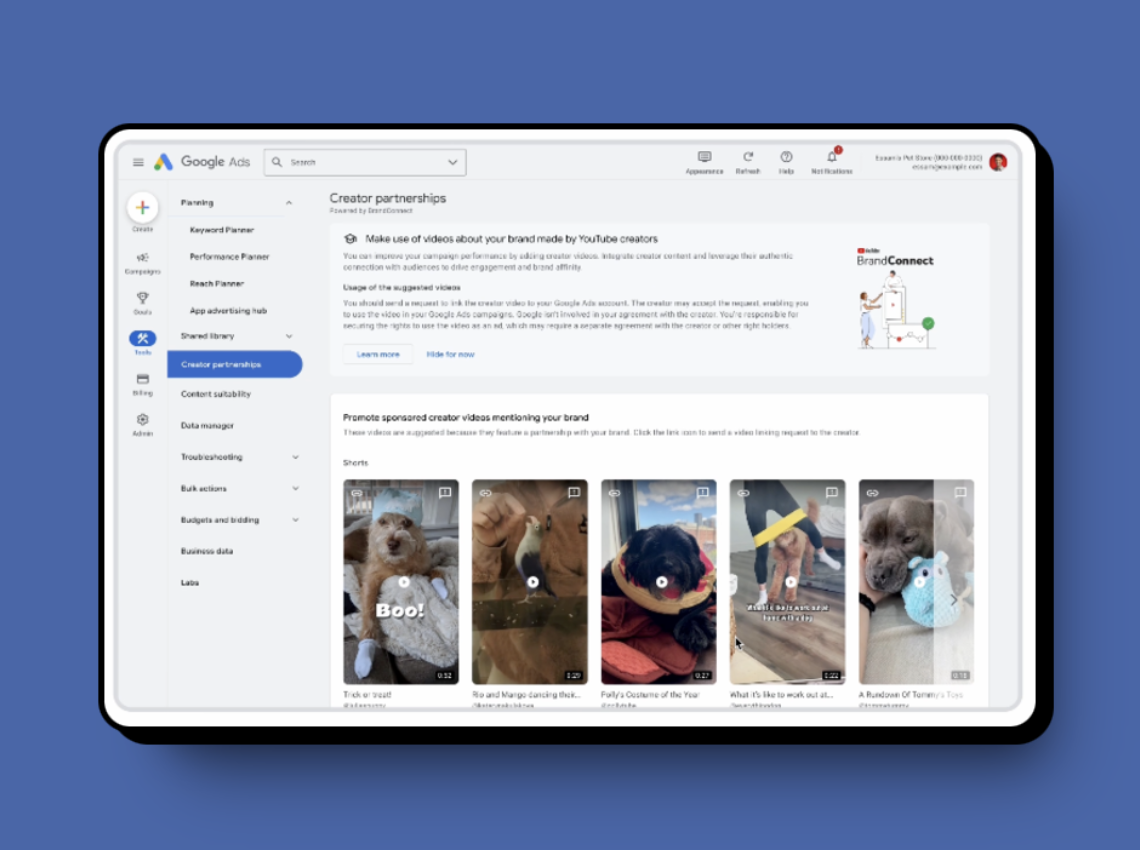
Creator and Video Tools Have Their Own Space

Video just got its own hub. The Creator Partnership Hub gives advertisers a dedicated place to:

  • Discover YouTube creators

  • Explore creator led video content

  • Align video strategy with Demand Gen and YouTube campaigns

This isn't subtle: video and creative aren't optional anymore. They're core to performance.

What This Means for Your 2026 Strategy

The interface updates point to where Google thinks the game is headed. Here's what to prioritize:

  • Use channel-level reporting: Performance Max finally shows you which channels drive results. Stop guessing, start optimizing based on actual data.

  • Set up brand search tracking: If you're running video, use Attributed Brand Searches to prove video's impact beyond direct conversions.

  • Get serious about video creative: Google built a whole Creator Partnership Hub. That's not a hint, it's a directive. Video isn't supplemental anymore.

  • Adapt to AI search behavior: Fewer clicks, higher CPCs, more AI-driven research. Your campaigns need to show up in AI results, not just traditional search.

  • Track the full funnel: With longer conversion paths and AI doing the research, you can't just measure last click anymore.

Revel Marketing Partner’s Bottom Line

2026 isn't about learning a new interface. It's about adapting to how people actually search now, with AI doing the heavy lifting and fewer clicks to go around.

The advertisers who invest in video, use the new reporting tools, and optimize for AI-driven search will win. Everyone else will wonder why their CPCs keep climbing while results stagnate.

SOURCES

2026 Digital Marketing Trends: Expert Predictions for Paid Media & Ecommerce

2026 Digital Marketing Trends: Expert Predictions for Paid Media & Ecommerce

Every January, the digital marketing world floods with predictions: some insightful, many recycled, and a few wildly off base. But 2026 feels different. We're not just watching incremental platform updates or minor algorithm tweaks anymore. We're witnessing fundamental shifts in 2026 marketing trends: how consumers discover products, how platforms deliver ads, and how marketers prove their work actually matters. The gap between brands that adapt and those that cling to old playbooks is about to become a chasm.

So we asked our team at Revel Marketing Partners where they think the industry is headed this year. What follows isn't speculation from the sidelines. These are predictions from the directors and leaders who are already navigating these changes with our clients, and who have strong opinions about what's coming next.

Revel Marketing Partners’ 2026 Digital Marketing Predictions

AI and Headless Commerce Are Reshaping the Shopping Experience

Kayla Faires, Founder & CEO:

"The future of digital marketing is about rebuilding infrastructure so you can move as fast as the platforms change. Two shifts are converging: headless ecommerce architectures, and agentic search systems where AI answers questions and makes recommendations before consumers reach your brand. Creative velocity and experimentation speed now determine ROAS, and legacy platforms are making it harder and harder to deliver. At the same time, discovery is shifting from queries to AI-mediated recommendations. Brands will compete less on keyword ownership and more on structured, machine-readable truth: clean product data, pricing logic, availability, and positioning that agents can interpret and recommend. As automation increases, judgment becomes the differentiator. The winners will pair flexible infrastructure with authentic brand building. Brands that actually stand for something and show their authenticity, while also leaning into new tech will compound advantages while others optimize yesterday's funnel."

Michele Keating, Account Director:

"Short-form video, AR try-ons, and creator demos won't just support ecommerce—they'll replace traditional PDPs. Live shopping will become the default, and UGC becomes the most trusted conversion asset."

AI-Powered Search and the End of Traditional Search Behavior

Abby Peterson, Director of SEM:

"2026 will mark the inflection point for paid search as AI advertising platforms fundamentally compress the user research journey. What once took 10+ searches now happens in a single ChatGPT conversation. Google Paid Search will remain a revenue powerhouse, but declining traffic volumes and intensifying CPCs will force a strategic reckoning: we can no longer afford to bid broadly. Success in this new landscape belongs to marketers who get ruthlessly selective with keyword targeting, double down on high-intent bottom-funnel terms, and maximize every click with precision audience strategies. The brands that will win aren't fighting this shift, they're adapting their strategies across both ecosystems while search is still profitable."

Brandon Elston, Paid Media Specialist:

"Brands that invest in GEO to appear in LLMs like ChatGPT & Gemini, will finally see a noticeable impact on purchases, especially from new customers. With the introduction of Universal Commerce Protocol (UCP) and direct integration of ChatGPT to Shopify, it is becoming increasingly more beneficial for consumers to shop on LLMs compared to search engines. This is because users can shop products across brands and make a purchase all in one ecosystem without browsing dozens of sites for inventory, products, or to find the best deals. A survey from Centerfield last year showed that the top 3 reasons users shop with AI are getting answers to product questions, comparing products or brands, & getting product recommendations, all top of funnel discovery type searches that could lead to discovering new brands and products."

Raw Creativity and Authenticity Will Beat AI Perfection in 2026

Paige Baugnet, VP of Client Services:

"I predict that we'll continue to see authentically raw and unpolished creative perform exceptionally well in 2026 as a direct counter to AI-generated perfection, particularly as consumers become increasingly skeptical about distinguishing real from fake content. In a digital landscape saturated with polished, algorithm-optimized visuals that all start to look eerily similar, people will actively crave authenticity and realness—the imperfect lighting, the shaky camera work, the unfiltered moments that signal genuine human creation. Brands that lean into this 'intentionally unpolished' aesthetic beyond the existing creator playbook will likely see stronger engagement and trust metrics, as audiences reward the vulnerability and transparency that comes with content that feels unmistakably human."

Jessica Shepherd, Chief Operating Officer:

"In 2026, the digital marketing industry will feel the real disruption not through job loss, but through the loss of excuses for mediocre thinking. As AI makes execution cheap, taste becomes a true competitive advantage—especially for beauty, fashion, and lifestyle brands where differentiation lives in nuance, not volume. The biggest brand risk won't be getting AI wrong; it will be sounding like everyone else who got it 'right.' That's why human review will increasingly serve as the new quality assurance layer—not to slow creativity down, but to protect brand distinctiveness in an automated world."

Marketing Mix Modeling, Diversification and the Shift to Incrementality

Amanda Moorhead, Account Director:

"2026 is going to be all about incrementality and accurate measurement for marketing. Last-click attribution isn't telling enough of the story, privacy changes are throwing a wrench into reporting, and relying on the same old methods is going to bring lackluster results. The brands that will unlock growth are those who can answer one critical question: 'What actually moved the needle?' That's why I'm excited to work with my clients on implementing MMM tools and diversifying their media mix. The future isn't about which touchpoint gets credit—it's about proving which dollars are truly incremental."

Gretta Schultz, Director of Paid Social:

"2026 is the year digital marketing finally gets its "infrastructure" right - better measurement, smarter and more consistent/reliable automation, and creative journeys that prioritize sustainable growth over quick wins."

RMP Affiliate Marketing Team:

"We predict affiliate programs will prioritize channel diversification and robust partner vetting following high-profile removals like PayPal Honey, while navigating increased FTC enforcement under the Consumer Review Rule that rewards proactive compliance. We expect the industry to accelerate its shift from last-click attribution toward outcome-based models that credit partnership contributions, as both affiliate and creator marketing mature with greater emphasis on measurable ROI over vanity metrics. Affiliate publishers will continue expanding beyond Google Search dependence through multi-channel strategies spanning social platforms, direct traffic, and emerging opportunities like OpenAI's ChatGPT ads. Meanwhile, long-term creator partnerships will become the standard as brands recognize the value of sustained relationships, with emerging content formats and technologies requiring affiliate programs to evolve their partnership structures and compensation models accordingly."

What This Means for Your 2026 Strategy

The through-line in all of these predictions? 2026 rewards the strategic over the reactive. Whether it's demanding proof of incrementality, embracing rough authenticity over AI polish, adapting to compressed search journeys, optimizing for AI-powered discovery, or protecting brand voice in an automated world, the brands that will thrive are those willing to challenge their assumptions and evolve their approach. The tools are getting smarter, the platforms are getting more automated, and the consumer is getting more discerning. Your strategy needs to keep pace. At Revel Marketing Partners, we're not just watching these shifts happen. We're actively helping our clients navigate them. If any of these predictions hit home and you're wondering how to adapt your own marketing strategy, let's talk. Because the future isn't something that happens to you. It's something you build toward, one smart decision at a time.

Revel Interactive Rebrands as Revel Marketing Partners to Reflect Its Evolution and Focus on True Client Partnership

FOR IMMEDIATE RELEASE

DENVER, COLORADO // JANUARY 30, 2026 — Revel Interactive today announced its rebrand to Revel Marketing Partners (RMP), marking a meaningful next chapter for the agency and formalizing a shift that has been years in the making.

Since its founding, RMP has been focused on connecting brands with people in meaningful ways. As digital marketing has evolved, so has the agency. What began as an interactive marketing shop has grown into a full service digital marketing partner that works closely with clients to shape strategy, guide decision-making, and drive measurable growth.

“Partnership has always been at the center of what we do, and this rebrand makes that clear” said the RMP team.

An Evolution Rooted in How RMP Works

The shift to RMP is not a change in direction. It is a clearer expression of the agency’s role as an extension of its clients’ teams. The agency focuses on performance-first digital marketing, guided by close collaboration, constant iteration, and a practical mindset that treats every recommendation as if the budget were their own.

RMP believes agencies should do more than execute tasks. The team works alongside clients to challenge assumptions, uncover opportunities, and help brands become stronger marketers over time. The goal is not just short-term performance, but long-term capability and confidence.

This approach has shaped RMP’s growth, its client relationships, and its point of view. The new name reflects that reality and sets the stage for what comes next.

What Has Not Changed

While the name and visual identity are new, RMP’s foundation remains the same. The agency continues to operate according to a set of core values that guide how it works every day.

RMP chooses action and accountability, turning ideas into results. The team focuses on strategic impact by pairing curiosity with clear goals and measurable outcomes. Humor remains part of the everyday, helping the team do serious work without taking themselves too seriously.

Courage plays a key role as well, pushing the team to step outside comfort zones and continue learning. Respect and openness guide every relationship through transparency, professionalism, and trust. Above all, RMP is committed to partnership with its clients, offering straightforward guidance and long-term collaboration as a true extension of their teams.

“These values have guided our work from the beginning,” the team shared. “They are staying exactly where they are.”

Looking Ahead

Revel Marketing Partners represents a more accurate reflection of who the agency is today. With a refined identity and the same commitment to performance and partnership, RMP is focused on helping clients navigate change, grow with intention, and build for the future.

Same people. Same mindset. Just a name that finally fits.

For more information, visit revelmarketingpartners.com.

About Revel Marketing Partners

Revel Marketing Partners is a digital marketing agency that works as an extension of its clients’ teams. Through close collaboration, strategic thinking, and a practical approach to growth, RMP helps brands drive results today while building stronger marketing foundations for the future.